
Forex trading steps
Learning how to trade any market can seem daunting, so we’ve broken forex trading down into some simple steps to help you get started:
- Decide how you’d like to trade forex
- Learn how the forex market works
- Open a Exness Broker trading account
- Build a trading plan
- Choose your forex trading platform
- Place your first position
1. Decide how you’d like to trade forex
A lot of forex trading takes place between major banks and financial institutions, which buy and sell massive amounts of currency every single day. For individual traders who don’t have the means to make billion-dollar forex trades, though, there are two main ways to get involved: spot forex or trading forex via a broker.
SPOT FOREX TRADING
A spot forex position is a way to trade on currency price movements that involves forecasting the direction in which a forex pair’s price is headed. The further it moves in that direction, the greater your profit. The further it moves in the opposite direction, the more you lose. The actual amount that you make or lose is determined by the size of your trade.
All spot forex trades take advantage of leverage. Leverage allows traders to get exposure to large amounts of currency without having to pay the full value of their trade upfront. Instead, you only put down a deposit known as margin.
LEVERAGE EXAMPLE
.png)
The amount you gain or lose will still be calculated based on the full size of your position, though. So your profits and losses can be far greater than the amount you put down to open the trade, and your losses can sometimes even exceed your initial deposit.
Find out more about how a spot forex trade works.
.png)
FOREX TRADING VIA A BROKER
Forex trading via a broker – or sometimes via a bank – works in a broadly similar way to retail trading. You’re speculating on the price movements of currency pairs without actually taking ownership of the currencies themselves. If you think a currency pair’s price is headed down, you can go short instead of long.
2. Learn how the forex market works
One of the first things to learn when you want to trade currencies is how the forex market operates, which is very different to exchange-based systems such as stocks or futures.
Instead of buying and selling currencies on a centralized exchange, forex is bought and sold via a network of banks. This is called an over-the-counter, or OTC, market. It works because those banks act as market makers—offering a bid price to buy a particular currency pair and an offer price to sell a forex pair.
GLOBAL TRADING CENTERS
.png)
Forex trading happens all around the world, and the biggest trading centers are New York, London, Tokyo and Sydney. This is why currency pairs are available to trade 24 hours a day. When the Asian session ends, the European one begins; when the European one ends, trading starts up in North America.
TRADING VIA FOREX PROVIDERS
Most retail traders, though, won’t buy and sell forex directly with one of the major banks – they’ll use a forex trading provider, such as Exness Broker. Forex trading providers deal with the banks on your behalf, finding the best available prices and adding on their own market spread.
3. Open a Exness Broker trading account
If you want to trade spot forex, you’ll need an account with a leveraged trading provider. You can open a Exness Broker forex account in minutes, and there’s no obligation to add funds until you want to place a trade.
4. BUILD A TRADING PLAN
This is particularly important if you’re new to the markets. A trading plan helps take the emotion out of your decision-making as well as provide some structure for when you open and close your positions. You might also want to consider employing a forex trading strategy, which governs how you find opportunity in the market.
Once you have chosen a particular forex trading strategy, it’s time to apply it. Use your favorite technical analysis tools on the markets you want to trade and decide what your first trade should be.
Even if you want to be a purely technical trader, you might also pay attention to economic developments that look likely to cause volatility. Upcoming economic announcements or data releases, for instance, might well reverberate across the forex markets – something your technical analysis might not consider.
5. Choose your forex trading platform
The right platform will enable you to both react quickly when you spot an opportunity and trade seamlessly whether you’re at your desk or on the move.
Our intuitive trading platforms can provide a smart and fast way to trade forex. You can trade via the Exness Broker trading platform on:
- Your web browser
- Our mobile app
- Advanced third-party platforms like MT4
Each of our forex trading platforms can be personalized to suit your trading style and preferences with personalized alerts, interactive charts and risk management tools.
6. Open, monitor and close your first position
Once you have chosen your platform and funded your account, you can start trading. Open the trade ticket for your selected market, and you’ll see both a buy and a sell price listed. You’ll also be able to decide the size of your position and add any stop-losses or take-profits that will close your trade once it reaches a certain level.
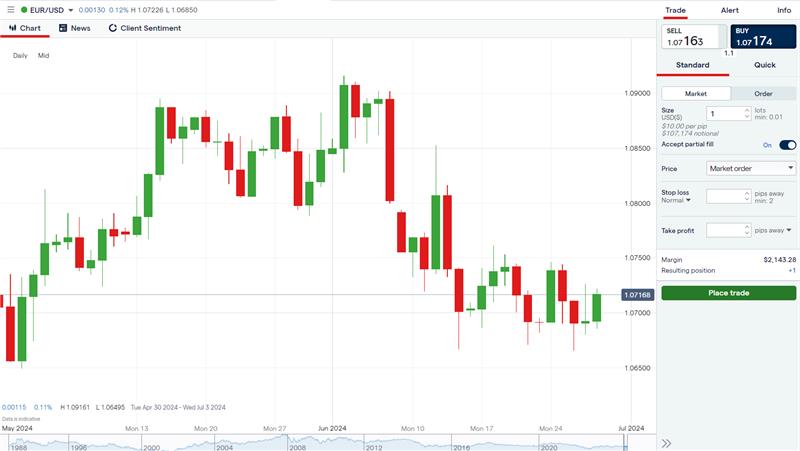
Hit buy to open a long position or sell to open a short position. When you’ve decided it’s time to close your position, just make the opposite trade or press close from the positions tab.
Forex trading example
All forex trading works in a fundamentally similar way – you take advantage of the movement of one currency against another in a pair, earning a profit if you predict the pair’s movement correctly and incurring a loss if you don’t.
Find out more about trading forex at Exness Broker with our trade example below.
TRADE EXAMPLE: BUYING EUR/USD
Suppose EUR/USD is trading at 1.11280, with a buy price of 1.11284 and a sell price of 1.11276, giving it a spread of 0.8 pips. You think that the euro is set to gain value against the dollar, so you decide to buy the market at 1.11284.
The size of the position is measured in lots, with each lot equal to 100,000 of the first currency (the base currency) in the pair. In this case, buying a single lot of EUR/USD is the equivalent of trading €100,000 for $111,284. You decide to buy three, giving you a total position size of $333,852. This means you’ll earn (or lose) $30 for every pip of movement (0.0001 USD/EUR). This is called your pip value.
Forex trading is a leveraged product, so you don’t have to pay the full value of your position upfront. EUR/USD has a margin factor of 2%, so you only have to commit $6677.04 – or €6000 – as margin.
.png)
If your prediction is correct
The dollar depreciates against the euro, and EUR/USD is now trading at 1.11530, with a buy price of 1.11534 and a sell price of 1.11526. You reverse your trade to close your position, so you sell three lots at 1.11526.
Your €300,000 is now worth $334,578, because 1.11526 x (100,000 lot size x 3) = $334,578. $334,578 – $333,852 = $726, which is your profit from the trade. You could also calculate this as 1.11526 – 1.11284 = 24.2 (pips), which you multiply by $30 per pip (your pip value) to get $726 ($30 x 24.2 pips = $726).
You will incur funding charges if you keep your position open overnight, which is an industry standard.
.png)
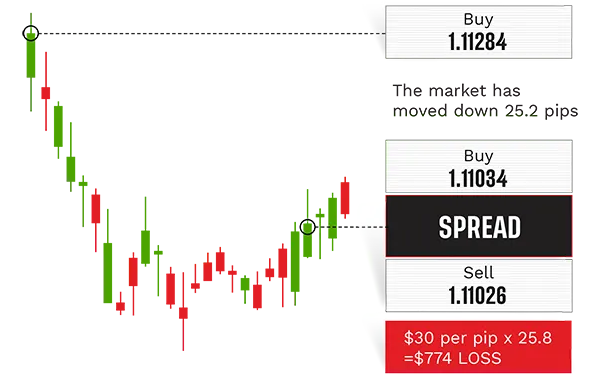
If your prediction is wrong
The dollar strengthens against the euro, and EUR/USD is trading at 1.11030, with a sell price of 1.11026.
1.11026 x (100,000 lot size x 3) = 333,078, which means your three lots are now worth $333,078, $774 less than when you opened your position. Another way to calculate this is to subtract 1.11026 from 1.11284, which gives you a loss of 25.8 pips. 25.8 x $30 per pip value = $774.